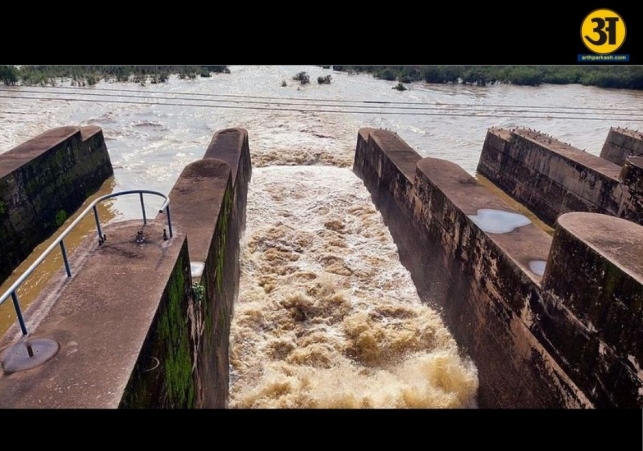
Pong dam level falls below danger mark
Pong dam water level dips below danger mark after 18 days of concern
After more than two weeks of worry, the water level at Pong dam on the Beas River has finally gone below the danger mark. For 18 straight days, the dam was holding water above its safe limit, which had added to floods in several areas of Punjab. On Friday evening, officials confirmed that the water level had dropped to 1,389.97 feet, slightly below the maximum capacity of 1,390 feet. This was the first time since August 26 that the dam was out of the danger zone.
Water flow in Beas River and nearby areas
The Pong dam, which receives water from Himachal Pradesh’s catchment areas, had been storing excess water due to heavy rains. On Friday morning, the inflow into the dam was recorded at 34,559 cusecs, but by evening it had risen sharply to 56,713 cusecs. To manage this inflow, the authorities released 49,624 cusecs of water into the Beas River.
As a result, at Kapurthala’s Dhilwan gauge, the flow in the Beas River increased to 85,123 cusecs. This rise in the river’s flow is being closely monitored as people living along the riverbanks have already faced serious flooding in the last two weeks. In districts like Hoshiarpur and Kapurthala, fields, houses, and roads were submerged, forcing many residents to evacuate.
While the drop in the Pong dam’s level is a relief, officials continue to warn that heavy inflow from Himachal could still keep river levels high. Flood control authorities are keeping watch and issuing alerts where needed.
Situation at Bhakra dam and Gobind Sagar Lake
Alongside Pong dam, the condition of Bhakra dam is also under observation. On Friday, the water level at Bhakra’s Gobind Sagar Lake was measured at 1,676.66 feet, which is just below its danger mark of 1,680 feet. This was seen as a positive sign, as it meant that both major dams in the region were not at critical points at the same time.
The Bhakra dam received an inflow of 59,667 cusecs on Friday. To balance this, the authorities released 55,000 cusecs of water downstream. This careful release is meant to avoid sudden pressure on rivers while ensuring that the dam does not cross its maximum capacity.
These controlled releases are important because sudden discharge of large volumes of water can increase the risk of flooding in low-lying areas. Officials have been trying to strike a balance between storing enough water for future use and protecting nearby districts from floods.
Impact of high water levels
Since late August, the Pong dam’s water level being above the danger mark had worsened flooding in Hoshiarpur and Kapurthala districts. Villages close to the Beas River were among the worst hit. Crops were destroyed, roads were damaged, and several families had to move to safer places. Relief efforts have been going on in these areas, with food and shelter provided to affected residents.
ALSO READ: Non-communicable disease deaths surge in India, women face greater burden
ALSO READ: France rocked by violent protests as political crisis meets public anger
Now that the water level is under control, people are hopeful that the situation will improve. However, they remain cautious because inflows from the hills of Himachal Pradesh can change quickly, depending on rainfall. Any sudden increase in rain could again raise the dam levels and the Beas River flow.
Monitoring and safety measures
Authorities at both Pong and Bhakra dams are keeping constant track of inflow and outflow. They are also coordinating with district administrations to inform people about possible flood risks. Safety alerts are being sent to villages and towns along the Beas River whenever discharge levels increase.
Experts say that these incidents show the importance of better flood management systems in Punjab. Heavy rainfall in the hills often creates pressure on dams and rivers downstream. By using technology and timely planning, officials hope to reduce the damage caused by such floods in future.
The fact that Pong dam has finally gone below the danger mark after 18 days brings relief to the people of Punjab. But continued monitoring will be crucial until the monsoon completely withdraws.
Related News